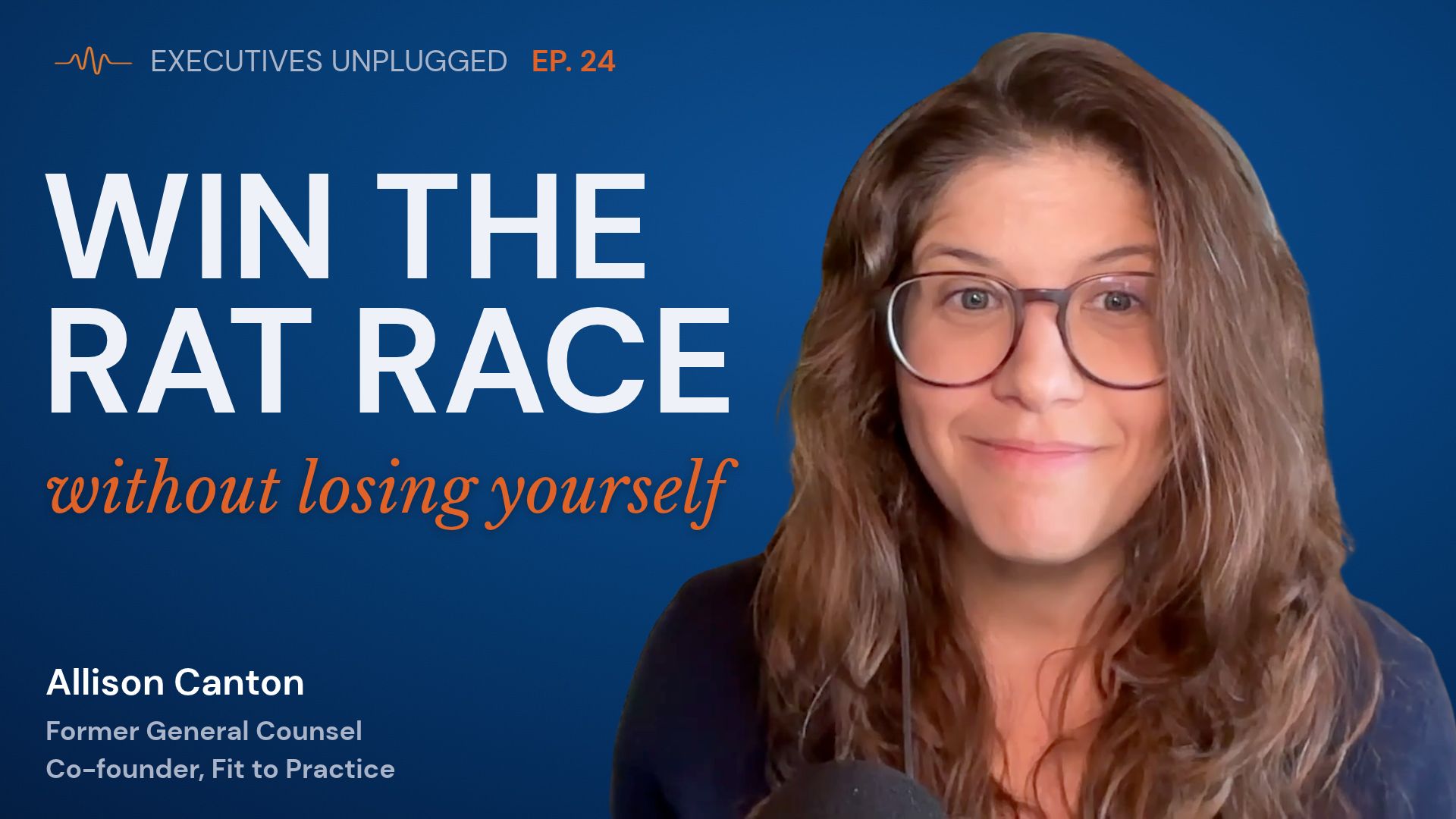
Doing what's best for you sounds obvious until you're a high achiever surrounded by status, prestige, and everyone else's expectations.
Allison Canton has lived that tension, from Harvard Law to big law to startup general counsel, and in this episode she gets brutally honest about what it takes to trust your own judgment. We talk about how your environment influences your decisions, the difference between healthy ambition and ego, and the night she woke up and wrote "I CAN'T DO THIS!" Getting from there to a decision took time, a change of scenery, room to think, and daily habits she keeps coming back to. If you want to truly choose your next destination instead of just following the status train wherever it goes, this one's for you.
Allison Canton
Allison Canton is a former startup general counsel and the co-founder of Fit to Practice. After Harvard Law and Ropes & Gray, she helped build companies including Flatiron Health, then stepped off the executive track. She now writes about achievement, success, burnout, and meaning. You can find Allison on LinkedIn and at allisoncanton.com.
Keith Cowing
Rat races can actually be fun if you're winning the race.
Allison Canton
I woke up in the middle of the night one night and I just grabbed a pad of paper near my bed and I wrote, "I can't do this. This is killing me. I need to quit." In all caps.
This shoe no longer fits. It's an amazing shoe, it's a beautiful shoe, it could go super far, but it just doesn't fit anymore. I gotta take it off.
Keith Cowing
This is Executives Unplugged. I am Keith Cowing, your host and executive coach, and with me today is Allison Canton. Allison followed a prestigious path. Harvard Law, one of the best law firms in Boston, associate general counsel, general counsel, the whole resume. Then it all came to a head and she needed to make a change. Today she writes about achievement, success, burnout, and meaning.
And we can all learn a few things from her story about how to make the big decisions that shape our lives. This conversation is about status, the pull of prestige, the stories we tell ourselves, and the environments that steer our decisions more than we realize. And it's about how to take back control: how to clear your head, change the narrative, and surround yourself with people who pull you in the direction you want to go. At the end, I ask Allison the toughest question of the day, one you might struggle with as well. But to understand how she got off the path, let's start with how she got on it.
Allison Canton
So it was 2009 and I was a first year at Harvard Law at the time. And I went to law school, this is maybe a longer conversation, really as a side quest on my way to a PhD.
Keith Cowing
So you went to Harvard Law by accident, is what you're claiming.
Allison Canton
I know it sounds like such a jerk saying that, but I did go to Harvard Law by accident. I didn't mean to go there.
Keith Cowing
This doesn't happen very often, so let's hear more.
Allison Canton
All right. So I was going to get a PhD to study the effect of mass incarceration on families and communities.
Keith Cowing
What got you interested in that? Where did that come from?
Allison Canton
It's a great question. I have a family member who at the time was incarcerated, who had been serving out a 15-year sentence. And as a result of visiting them in prison and really seeing how the criminal justice system operated, I realized, to put it bluntly, the system's fucked, right? We're creating really devastating harms, both on families and on communities, and not even just communities, whole zip codes at this point were being really eviscerated by the lack of Black and brown men and father figures in them. So I thought it would be really interesting to take this personal experience and study it from an academic perspective, with the goal of actually trying to make reforms and change things.
What I realized as I was working on my application was that it was actually all of these complicating federal, state, and county laws and systems that were operating on people's lives and making things so difficult. So I figured, okay, if I'm going to do this PhD, I probably should get a JD so I actually really understand how the law works, and maybe I can do more effective advocacy to make a change.
I put together my applications, I study for the LSAT real quick, and then I add a law school application to all of my PhDs. And the way things shook out, I got into Harvard Law and I didn't get into the PhD program. And knowing as little as I did about what law school was actually about, I just said, oh, well, first year of law school, I'll have plenty of time, I'll work on my application. It's just so funny how out to lunch I was. I'll work on my application, I'll build relationships with professors, and I'll get in next year. Obviously, none of that happened.
Keith Cowing
I like the lens of decision making. You added law school to your set of options. Then you decided to go, which is a pretty important life-changing decision. Once you go down that path, it's hard to revert. So put me in that moment.
Allison Canton
Yeah, so admissions decisions were coming in in 2009.
Keith Cowing
Okay, so the middle of the financial crisis.
Allison Canton
The middle of the financial crisis. I am deciding to sign up to be a broke PhD student for the next seven to ten years, or to actually do something that made money. What was interesting is that I really was excited about being a broke PhD student, and I was not that excited about making money. But all of the people around me who were advising me on the process, professors at Columbia where I'd been working as a research assistant in the School of Public Health, some of my own college professors, everyone said if you ever want to do something in the law, or even just generally in this world, you've got to go to the best school you got into. You got into Harvard Law, so you're going. And I said, well, I actually don't want to be a lawyer. And they said, it doesn't really matter. Once you go to Harvard Law, everything else will be possible.
Keith Cowing
You've opened the one door that opens all future doors.
Allison Canton
Exactly.
Keith Cowing
Now let's fast forward a little bit. You're coming out of law school, you end up at a prestigious law firm. Tell me about that next part of your journey.
Allison Canton
Yeah, so just like I never wanted to go to Harvard Law School, and I'm going to sound like such a joke, people are going to hate me, I never wanted to go to a big law firm. Because again, the idea behind going to this PhD program or law school was to do public good. I very much considered myself a public interest person.
And at Harvard, there really was a divide at the time between public interest and non-public interest people. So I almost didn't even apply to any law firms. I had decided that I wasn't going to participate in the on-campus interviewing program, where all of the law firms converge on the Charles Hotel and take over every single hotel room. You go in and you interview with 12 different law firms in one day, and you're getting decisions and callbacks that same night. It's a really intense, high-pressure environment.
So I told my friends, I'm not doing it, no shot. And I remember my friend sat me down. It must have actually been 2010 at the time, but we're still in the thick of the recession. And they said, "Allie, people do not have jobs right now. Meanwhile, law firms are desperately knocking down the door of Harvard Law students. You need to get your butt to the Charles Hotel. Also, by the way, you're about to have $300,000 in debt, and I don't know how you plan on paying it off on a $40,000 a year public interest salary."
Keith Cowing
The decision you had to make was not yet, do I go to a law firm. It was simply, do I put myself in the process such that I might have the option to go to a law firm, right? And who was making that decision? There's your self-conscious self, there's your real internal confident self, there are the pressures around you, the environment making decisions for you. In that moment, who was making the decision? Which avatar?
Allison Canton
I would say there was definitely social pressure. Law is a very status- and prestige-obsessed profession, and I saw that from the moment I got to Harvard Law. It was always, okay, are you in with this professor? Are you doing office hours with them? Are you reading this hornbook? Are you participating in this club or this journal that unlocks the next thing? Everyone's playing 5D chess all the time to assure maximum possible prestige outcomes. And I had told myself that I was above all that. I didn't care. I wasn't going to play that game.
Keith Cowing
You weren't going to play the game. Now, you said you told yourself. Did you believe that?
Allison Canton
I believed it. But when you see your peers, and not just random gunners but your friends, who you share a lot of similar values with, making decisions that are really different from yours and joining that status quo, default path majority, I think one can't help but have some questions. Just a little nagging sense in the back of your head of, am I really doing the right thing? Do I actually know what I'm doing? We all, deep down, are saying, I actually don't know what I'm doing. But I have some idea about what I might be doing.
Keith Cowing
Right, of course.
Allison Canton
For a long time the money and the prestige didn't appeal to me, but it was the process of interviewing itself. Once I got to the Charles Hotel, I had my little list, where I had tried to identify which law firms had the most public-interest-adjacent practices. So I was only interviewing at places that had strong nonprofit law or healthcare law practices, firms that scored high on quality-of-life measures and that let you count the most pro bono toward your hours. That was the filtering framework I went in with.
And then when I was there, there's just such a buzz of energy in those halls of, well, are you interviewing with Cravath? Are you interviewing with Wachtell, or Wilson? Why not? Those are the best, those are the ones you should be going to. And I was like, no, no, I have my list, I'm going to do it this way. But as I was interviewing, very quickly the decision shifted. It wasn't, let me give myself some optionality by going through this process and then decide if I'm going to work at one of these firms or do another public interest internship next summer. It became, which of these firms am I joining next year?
And the secret is, even then, when the recession was in full force, pretty much everyone got an offer. If you got an offer to join the summer associate program, you were pretty much guaranteed a job offer at the end of that summer, so long as you didn't get blackout drunk and email the whole firm. It really was a guarantee. So that set me off on this other default path, which was not the one I had imagined for myself, but one that I increasingly convinced myself was the right thing to do. Because okay, I'm going to pay off my loans, and that money is real and those interest rates are real. I'm going to learn a lot. I'm going to work in this high-status environment. I ended up going to Ropes & Gray, which is one of the best firms in Boston. We had the Ropes & Gray room at Harvard, and I felt very good about myself being associated with that brand and that institution.
But it wasn't all status and money. I loved that I joined the healthcare group. Most of my clients actually were nonprofits, about half of them. And more importantly, I was working with really incredible, kind, and brilliant people. So it wasn't a bad decision to make.
Keith Cowing
And how did you feel when you made the decision to take the offer?
Allison Canton
I was excited, because again there was this general buzz of, which firm are you going to, where did you get the callback. It was just fun, honestly, being part of that chatter.
Keith Cowing
Rat races can actually be fun if you're winning the race. Let's not lie, it is exhilarating, right? There's something to that. Just proving it to yourself, too. It's not always proving it to somebody else.
Allison Canton
Exactly. So I felt a little bit of a buzz, I felt extremely lucky. But then there also was a little bit of this gnawing gut sense of, am I betraying myself? Is this really why I came here?
Keith Cowing
And how long did that linger? Was this a little thing in the back of your head that never quite went away?
Allison Canton
Yep. Especially when I'm working the really long hours, and when I'm working on these private equity deals that I know are actually leading to worse quality of care and more expensive healthcare costs for the general public. That stuff didn't feel really good, but it was my job and I had to do it.
Keith Cowing
Now you go on. We met at Flatiron Health, and you became an associate general counsel, then a general counsel at these startups, and you went through multi-billion-dollar acquisitions and due diligence and an amazing career. And then at some point you decided you wanted to get off the status train and do something very different. So walk us through that. What did that look like? And how did you make the decision that you'd been down this path for a while, but it was time to really get off of it?
Allison Canton
Where we met at Flatiron, and even at my later gigs, I would say for a long, long time I was having a lot of fun in my career. We were working on really hard problems, on important missions that were doing good in the world, working with excellent people, having fun along the way.
But what I think started to happen is that there was this narrative that I held, and that I think a lot of high-achieving folks hold, which is that we have to work really hard. Coming from an upbringing where we didn't have a lot of money, it really was: you have to work hard to get where you want to go. And that served me incredibly well academically and professionally. But at a certain point, I almost feel like the narrative outlived its useful life, or at least the undifferentiated way I was applying it.
Keith Cowing
And what narrative? This is something you're telling yourself? What was the story?
Allison Canton
This is the narrative: that if you want to be successful, you have to work really hard, and that...
Keith Cowing
What's wrong with that?
Allison Canton
Because I think the corollary, as I'm mapping it and saying it out loud, was that work was the most important thing.
Keith Cowing
That's very different from saying working hard.
Allison Canton
Yeah. Work was the most important thing because we were trying to achieve a certain level of, at least initially, material resource. Making ends meet, and then it becomes higher and higher. It's no longer about need, it's about want and enjoyment or whatever it is. But I'd really internalized this narrative that work was the most important thing, and I got that from my father and my grandfather.
My father came here from Honduras when he was a kid. My grandfather worked on a banana plantation in Honduras. And this is completely insane: he worked on the plantation that was owned by my law school classmate's grandfather. We literally sat next to each other. He was my section mate.
Keith Cowing
That's crazy. You say, you're welcome for doing all the hard work.
Allison Canton
Exactly. I'm like, where's my piece? But it really was true that work was the most important thing. It was in service of family, but my grandfather had seven kids to feed on a very meager salary, and then my father internalized that too. I do think their version was: work is the most important thing because this is really how I'm going to provide for what truly is the most important thing, which is the well-being of my family. I usually didn't grow up hungry. I didn't personally have that extreme sense of material need that my father and grandfather had. So I think I really just took the first part of the message and lost track of the corollary, which was that it really was about providing for your family.
Keith Cowing
You're talking about internal narrative, which is really important and changes a lot of our decisions and our approach to life. At a certain point, let's say getting that monthly paycheck becomes less existential. How did the narrative change for you?
Allison Canton
Well, the problem was it really didn't. I kind of just kept going down that path, maybe even operating with a little bit more of a scarcity mindset.
Keith Cowing
Why do you think that was?
Allison Canton
I'm not sure. It's interesting, because I'm a very self-reflective person, but that was almost my core operating mode. It was identity level. I didn't know it could really be a different way.
Keith Cowing
I've gone through similar things. I always self-identified with being the underdog that has to fight and crawl and just chase the thing because there's no choice. You have to chase the thing because you have to pay the bills. If you're down to your last dollar and you have to make a security deposit, guess what, you have to chase it. Then you have kids and you have to provide. So you chase and you chase. And then one day, if you don't have to chase anymore, it's all of a sudden, well, then why? And what now? Those are really hard questions to grapple with. And if you can't identify as the underdog anymore, then what does that mean for the story you've told yourself your whole life?
Allison Canton
Yes, I think you describe it perfectly. When I finally did end up leaving, it was basically three to five years after the Flatiron acquisition, which was a great acquisition. I certainly didn't have F-you or retirement money, but I'd made the most money I'd ever made in my life up to that point.
And then I'd made the decision to move out of New York City. This I think was a really big one in terms of shifting my narrative. When you live in New York City, everyone moves there to prove something, to be someone, to achieve, whether it's becoming a world-famous actor or the best lawyer or starting an amazing company. I always feel like you're going there to make it.
Keith Cowing
You don't go there just to chill and sit on the couch. There are a few people that do.
Allison Canton
Unless you have generational wealth, and maybe you do, but for most of us, no. So when I moved out of New York City, I moved intentionally, because there was this emergent part of me that knew that the most important things at this stage were family, community, and spirituality. That's what I explicitly wanted to prioritize in my post-Flatiron stage.
The challenge was that my operating system hadn't caught up with those values. So when some of our old friends reached out to me and said, hey, we're getting the band back together, we're starting a company, we just incorporated three months ago, do you want to join as employee 10, you'll get the GC title and be an executive and run people, the underdog fighter grinder said, I want to do that. That's my jam.
What's funny is that I'd actually already left Flatiron at that point, had taken six months off, and was actively trying to live a different way. I remember having those conversations, and there was this emergent, I won't say better me, but new me, who was saying, are you sure you really want to do that? That seems like a lot of work. That would probably take time away from your family, or from enjoying this beautiful new place where you moved to have a slower pace of life. Isn't working at a seed-stage startup fundamentally at odds with that?
Keith Cowing
But it's so much fun.
Allison Canton
Exactly. And then the other voice in me was like, no, this will be so much fun, and we'll figure out how to do it in a different way. Is it ambition or aspiration or ego? Those are all different flavors of the same energy, healthy and less healthy expressions. I'd say it was a mix of both, but there definitely was ego that wanted the GC title, that felt like I had been unfairly passed over for it at Flatiron, and that was going to prove to myself and to everyone else that I deserved it and that I was going to do it really well.
Keith Cowing
There's another thing I would love to hear your take on. That's the extrinsic version of proving something to the world. Then there's the intrinsic version, where I know myself, I like chasing things. It's just fun. And I don't think that's something you should actually turn off, at least that's my belief. You just have to be very, very careful about what you're chasing and why. If you have that personality type and you're chasing nothing, it may not be fulfilling. But if you're chasing the wrong thing, you're bringing yourself in a direction that doesn't really work for you. So there's the extrinsic version of the ego and the status, and then there's the intrinsic version of how do I fulfill myself, but put constraints around it, which is really hard. How do you define what you're chasing now? The healthy version of having something to chase?
Allison Canton
You're absolutely right, and I had to experience that back and forth. When I ultimately did leave my last executive job, I said, well, I'm not going to do anything, because I was overdoing, so now I need to experience not doing. I've come to realize, to your point, that the ability to chase absolutely is a superpower, but it's one that needs to be exercised very wisely and, at least as I get older, much more sparingly than I had in the past, where it was: I see a problem, I'm going to run after it, and I'm going to do that twenty times a day.
Keith Cowing
Sometimes people come to me and say, I have a hard decision to make. And I'll look at what they're deciding between, and there are two types of hard decisions. There are hard decisions where it's hard to figure out what the right path is. And there are hard decisions where you know what the right path is, but it takes courage to go down it. Which version was it, or when did it shift over? How did you get the clarity to be able to say, this is the right path, I just need to figure out how to do it, not if I should do it?
Allison Canton
That startup job felt like a good decision for a while, even if it wasn't necessarily the most aligned decision with my more aligned self at that moment. Nothing is ever perfect. That's the secret, right?
Keith Cowing
Nothing is ever perfect in this game.
Allison Canton
But the tension between this old narrative and this new set of values just became more and more acute, and I really came to a breaking point. There were a few times where I had breakdown crises, but I remember I woke up in the middle of the night one night and I just grabbed a pad of paper near my bed and I wrote, "I can't do this. This is killing me. I need to quit." In all caps.
Keith Cowing
Your inner self was just coming out whether you liked it or not. It's like, I'm taking over.
Allison Canton
I'm taking over. And I look at it in the light of day in the morning, because it went on for like three pages of this, and I was like, oh my gosh, this is something I really have to take seriously. I would say that was the beginning of the end.
I still continued to wrestle with the decision for a bit. I probably stayed for another nine months after that, both because it took a while to wind things down and because it took a while for me to make that really uncomfortable decision and break off from the path. I had people around me saying, oh my God, you're doing such a great job, you're crushing it, you're having such a big impact for the company, you're building this amazing brand and platform for yourself. And of course, as a type A, gold star student overachiever, I'm completely addicted to those accolades.
But she just kept emerging, and she kept saying: you need to ignore what those people are saying, you need to ignore what ego or that statusy little voice in your head is saying, because that stuff doesn't really matter. That's not what matters to you now. It became almost a deeper body-level knowing. At a certain point it was just clear: I am leaving here, and it is a matter of time. It's like this shoe no longer fits. It's an amazing shoe, it's a beautiful shoe, it could go super far, but it just doesn't fit anymore. I gotta take it off.
Keith Cowing
I'd love to hear about controlling your environment. Sometimes I look at a decision and ask how much of the outcome is in the moment, and how much of it is other decisions you made leading up to that: who you spend your time with, what you're around, what kind of mortgage payment you have, all these things that basically control the destiny before it even happens. So for example, if you hadn't moved out of New York City, do you think you would have made that same decision on the same timeline?
Allison Canton
Nope. No shot. I'd moved up to the Hudson Valley, again based on a felt sense. I have a vivid memory of driving down this one beautiful windy road on a fall day. I was still at Flatiron at the time, and I burst into tears. My husband's like, are you okay? What happened? And I said, I can't remember the last time I felt this much ease and this much peace. I said to him, I need to be indexing on this. This is the feeling I want to be living in.
The silver lining of COVID is that all of a sudden everyone could work from everywhere, and it actually did seem possible to reorganize my life around that feeling. But that was a conscious decision that this is the feeling that's going to come front and center, because I knew the most aligned version of me was going to be able to emerge from those conditions.
Keith Cowing
It feels from here that that physical move, in a way, set the stage for you to give yourself permission to have the courage to make the decision that had been building up over time.
Allison Canton
Yes, because of the people, too, the new friends I made and my neighbors up here. There are actually a lot of people who have big finance jobs or work in tech, but there are also a lot of people doing a lot of different kinds of things. And even if you have one of those big jobs, when you're up here, work is not really the thing people talk about. In New York City, the first question is always, what do you do? And let me immediately filter whether this person is worth my time, how is this person going to be helpful to me, or how am I going to be helpful to them, thinking transactionally about it. When you're up here, usually the question is, how do you enjoy spending your time? And people typically talk about hobbies. That's just really, really different. People actively don't want to talk about work. People come here not to think about work.
I didn't realize that when I moved here, but I think that cultural difference was actually really important in finally being able to realize that this isn't actually the most important thing.
Keith Cowing
You mentioned something before we talked about, a mantra of yours: suffering, then lessons, then blessings. We're getting to the blessing piece of that. We went through the suffering, which isn't all bad. Suffering is not always a negative thing. I think we have to suffer, or we can never get to the other side. You can have pleasure without suffering, but you can't have a true blessing without it. Going back to the lessons for a second, to give other people tools to make the decisions that are best for them: what have you learned from this whole journey that can help people at various stages of their own journeys figure out what the best move is for them?
Allison Canton
One of the big lessons for me from that period of suffering was that it doesn't have to look a certain way. After a fifteen-year career in law, where it was really prestige, status, hierarchical, this is what the next step looks like, for a while I was like, okay, after becoming a startup GC, obviously I'm going to become a public company GC, and then maybe a COO of whatever. It was always about what's next, what's next, in a very prescribed way. So learning that it really doesn't have to look any way at all was very liberating for me.
Keith Cowing
If you were going to give somebody advice on how to get that framing in their mind, what would it be? Is it getting out of the building? Is it practicing meditation, or some other hobby that gives them that mental space? How do you get there?
Allison Canton
I think there are two paths to that. One fast path, controversial fast path: go to Burning Man. Go for the whole week and you will see it does not have to look a certain way. It's funny, I did. I ended up going. I'd wanted to go since I was in college.
Keith Cowing
Is that part of your experience?
Allison Canton
I went in 2022, and that kind of exploded my mind about what was possible.
Keith Cowing
Maybe the meta version there is: put yourself in a radically different environment. Not 20 miles out of New York City. Another planet. That could be international, that could be this. I mean, Mark Benioff, when he left Oracle, spent six months in Hawaii just hanging out in the water, and that's when he came up with the idea for Salesforce. He said it was the most productive six months of his career. So a wildly different environment, right?
Allison Canton
Yes, make a big, big change. The other thing is play. Really value play. Try something new, whether it's a ceramics class or horseback riding or kite surfing or whatever, and just do it for the sake of adventure and curiosity and enjoyment. You try enough things and you start to revise your own sense of self, from "I'm a person who would never do that" to "I'm actually a person who really enjoys doing that." That unlocked my sense of self, and it gave me permission to start prioritizing in a different way than I had.
Keith Cowing
And all of those you mentioned, I'm guessing it's not accidental, are highly tactile, real world, out and about, not with a screen. It's grabbing the reins, it's falling in the ocean. Activities that give your brain a chance to heal and clear in a way I don't think you can otherwise. I remember you practicing ikebana, I'm probably pronouncing it wrong, this Japanese plant arrangement or something, where you're literally getting your hands dirty in the soil. It seemed like that was part of how you could get clarity and sort of break out from everything you'd been worrying about.
Allison Canton
Absolutely. I've been practicing Japanese flower arranging for fifteen, twenty years now, and it's exactly that. It's not at all mental. If I go in with an agenda or an intellect, the whole thing gets completely messed up. Actually working with the flowers, cutting them, seeing with fresh eyes, having a creative palette where no one's going to judge me and it's very low stakes if I put the flower this way or that way. Again, it's experimentation and turning off the mental narrative.
Keith Cowing
How do you get a clear head?
Allison Canton
I have a daily meditation practice. I've been doing that for fifteen-plus years now, and I find it really, really helpful. Sometimes my practice falls off the rails, and I actually find that when I'm most out of alignment, I'll realize I haven't practiced in a few days. Even that fact of not practicing is a sign that I'm letting this other energy, which isn't the energy of my most aligned self, really take the wheel. So I'm much more disciplined now about making sure it really is a daily practice, that I'm giving myself space for space.
Then I have a journaling practice that I use when I'm noticing I'm feeling out of alignment. I'll do this right after I meditate, and I'll ask myself, what does my most aligned self want me to know right now? And then I just start automatic writing whatever comes. That's usually where I end up surfacing some of these tensions, where I'll say, I've noticed I've been chasing after something because it's a shiny object, but it's taking me away from time with my family, or time for writing, or some of the community-building projects that really light me up and give me an inner fire.
The other thing is I really try to pay attention to my energy levels internally, and sense when I'm going from the buzz of excitement to almost an over-caffeinated adrenaline, almost semi-manic, where I'm just doing it. It's not from a place of creative inspiration, where the work is flowing through me. It's more of this over-efforting sense.
Keith Cowing
Final question, maybe the toughest one. Could you have gotten to the level of peace you have now without having gone through all of those moments, including the dark ones?
Allison Canton
I don't think I could have. I think I am wired for learning, and pain and suffering happen to be extremely effective teachers for me, and clarifiers about what I really prioritize and how I spend my time.
A little over two years ago, when I was pregnant with my second, with my daughter, I spontaneously decided to start praying. I was raised Catholic, and then I stopped praying, because I hate the Catholic Church and everything, whatever. I was not into that. All of a sudden, when I'm pregnant, I decided to start praying again. I didn't even decide. It just started happening. It was weird.
Keith Cowing
Did you wake up and write it on a piece of paper? I should pray, all caps.
Allison Canton
Pray more. But I will tell you that I've had pretty much the same start to the prayer for the past two and a half years, which is: thank you for this suffering, thank you for these lessons, and thank you for these blessings. And I say that every single night before I go to sleep.
Keith Cowing
Well, what a better note to end this on. Prestige is something you shouldn't do just for its own sake, but that doesn't mean that path isn't a good one for you for other reasons. You just have to be clear about why. And you mentioned the shoe doesn't fit anymore. Things change, so you have to re-evaluate once in a while: what's best for me right now? So Allison, thank you so much for joining me.
Allison Canton
Thank you, Keith. This was so much fun.
Keith Cowing
Where can people find you?
Allison Canton
People can find me at my website, allisoncanton.com. That'll be the great first stop, and it links out to my writing on LinkedIn. If you're interested in following along with explorations about achievement, success, burnout, and meaning, I'm writing about all of that on LinkedIn, so you can find me there.
Keith Cowing
Excellent. Well, I highly recommend people take a look. Thank you.
Allison Canton
Thank you.
Candid conversations with founders and execs about making critical decisions, building and aligning your team, and showing up at your best. I’m Keith Cowing, an executive coach and founder. Every week I’m in the room with leaders facing their hardest problems. This is where I share what I learn.
More episodes →