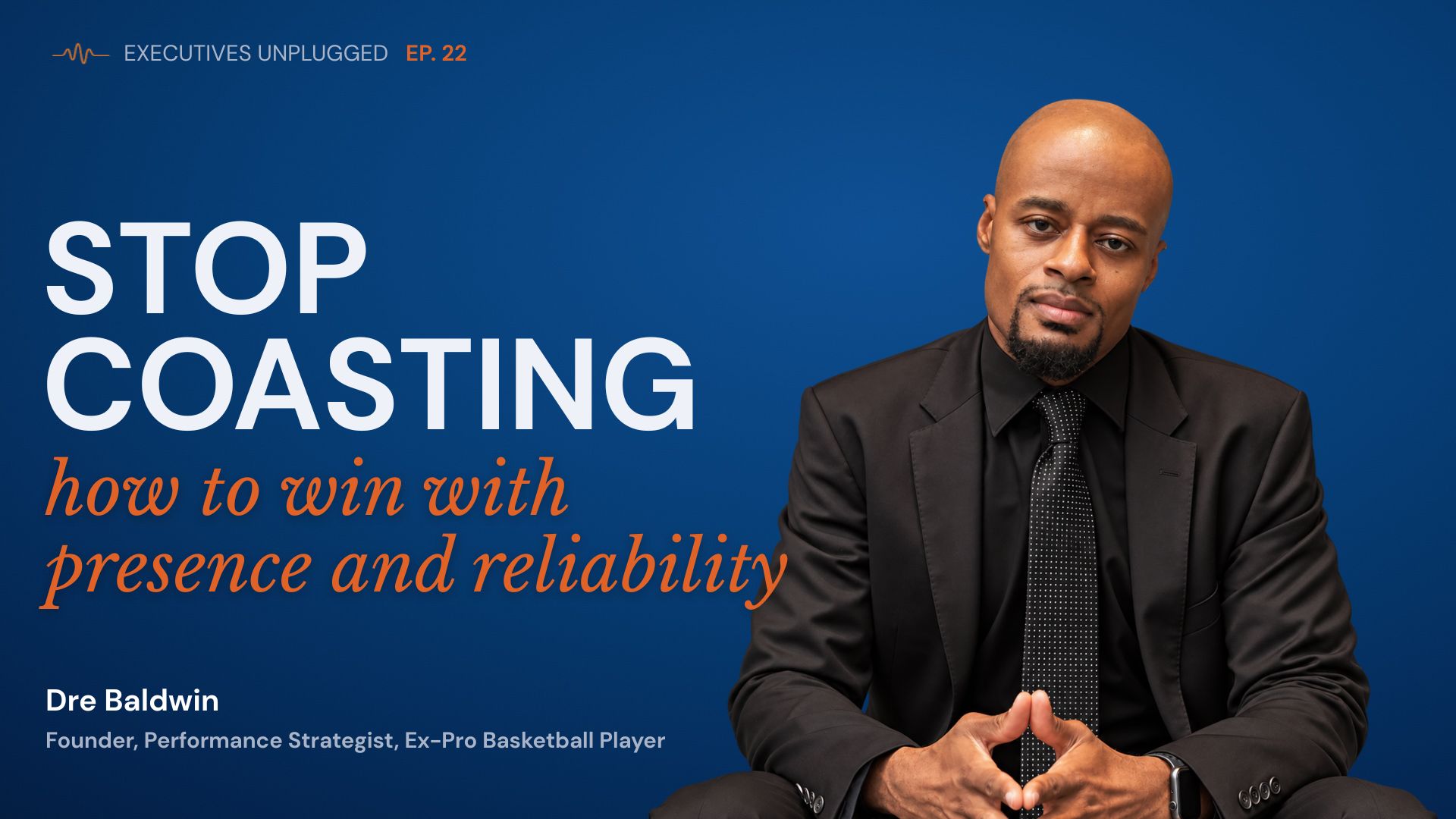
In today's world, how you show up is more important than ever.
Dre Baldwin started playing basketball at 14, came out of a Division III school and willed himself into a nine-year professional basketball career. He now brings the same discipline to executives and organizations. We talk about what makes great results repeatable, why leaders should measure execution and not just outcomes, and how reliability compounds into an advantage. We also get into Power Presence, Dre's approach to improving presence by removing noise, and why judgment and presence matter more as AI makes information and answers abundant.
Dre Baldwin
Where You Can Find Dre
Keith Cowing
This is Executives Unplugged. I'm Keith Cowing, your host and executive coach. And with me today is Dre Baldwin. Dre started playing basketball at 14, played at a D3 school, and willed his way into a nine-year career as a professional basketball player. Today he helps leaders execute and improve their presence. And with AI automating so many tasks, how you show up as a human is more important than ever. I learned a lot from talking to Dre, and I think you will too. Let's jump in. You've developed a scoreboard for your clients. Tell us a little bit about that. What's in this scoreboard and how did you develop it?
Dre Baldwin
Sure, it's called Execution Reliability Index. And what the execution reliability does is make sure that we can find out why the scoreboard says what it says. So we can use a sports analogy, which I'm sure we'll talk about in sports. The football team has a scoreboard. They can see we won this game, we lost this game. That tells you what happened, but it doesn't tell you why it happened. So execution reliability addresses one piece of the why. It's not all the why, but one critical piece of the why is, did we execute? on our proven validated process the way that we were supposed to because if we did not then we can look at the scoreboard and say well maybe that's the reason why the score looks the way that it does. If we did execute completely the way that we're supposed to according to ERI then we can look at other aspects of what we're doing because clearly it's not the execution that is at fault.
Keith Cowing
I've heard that the best basketball coaches will sit down with a team after the game and watch the film review and then frequently freeze frame it after the ball leaves the player's hand if there's a shot and then diagnose the play before they see if the ball went in to say, did we make the right decisions? Did we make the right choices? And if so, Excellent. That's an 80, 90% shot. You should do that all day long, whether or not it went in. And if somebody throws up a silly shot that they shouldn't have done because somebody was open and there was a bunch of time on the shot clock, but it goes in, you know, that's not rewarded because that's not the right process. Is A, is that true? I'm just curious in in basketball and B, is that part of what you're talking about? Making the right decisions, doing the right plays, and then separately whether or not the ball goes in will take care of itself if you're doing everything underneath right.
Dre Baldwin
Absolutely true and we call that film study and it happens in every sport basketball football baseball and I'll tell you a story from sports Lawrence Taylor I'm sure you know Lawrence Taylor was known as maybe the greatest rushing defensive player in the history of football and Bill Parcells who was his coach would tell him okay on certain plays are rushing the quarterback but then on there were other plays when he wasn't supposed to rush the quarterback because you know sometimes linebackers drop back in coverage for the receivers and Lawrence Taylor would go rush the quarterback anyway and he would make sacks and he would make big plays And coaches kept saying, hey, you're not supposed to do that. You're not supposed to do that. But he was so good at it that he would break the script and still make a great play. And eventually the coach said, OK, we just got to let this guy go. Now, there are some exceptions where if someone is going off script of the proven process on non-critical steps and they're still producing the results, then that can be tolerated. So execution reliability is not about turning your people into robots. the critical steps, for example, they say Lawrence Taylor. hey you have to line up behind the line of scrimmage otherwise there's a penalty and he kept lining up in the neutral zone and they get penalties, give away free yards. Well you can't do that. That's a critical step. You can't violate if that makes sense. So with an organization we need to know what the critical steps are, the things that must happen. So the example you use with basketball. Let's say a player takes a really bad shot and as you said even though it went in because a lot of people say well hey that's the result. The result is the ball went in. I had 30 points and I even I. I'm a person who always says, Keith, we are in a results based business, but that doesn't mean that's the only thing that matters. How did we get to the result? Number one, number two, is it duplicatable? Can we get to that result again and again and again? And also, especially you being a person who works with executives, you don't want the fact that you got to the result to be based on the individual talent of one superstar, because what happens when that superstar moves on and you have to replace them with someone else? And that person doesn't have the same talent or the same charisma. or these same unteachable traits, well, what's gonna happen to the company? Because everything is based on the talent of this one guy. So we wanna have a system that can be operated consistently and when someone is going off the grid of what the system is supposed to be, the proven process, well, we have to correct that so people understand. And in sports, we're using sports here as an analogy. And sports are a little bit different from business, Keith, I'm sure you understand. In sports, sometimes there are players that are just different. Lawrence Taylor is just different. Kobe Bryant is just different. 99 % of players you can't do what he does you had to follow the system, right? So he did that yes, but I'm just saying he you're not him and in the business world It's the same thing I think even more importantly because in business, it's not so clear the Connection between what happens and what goes on that scoreboard because the scoreboard in business is often a lagging indicator Meaning you don't see the results of what the CEO is doing until maybe six to twelve months after they started doing it whereas in sports The game starts 48 minutes later, the game is over. We know what happened exactly what we can look at it in this small box. In business, the box is a lot bigger. There are a lot more moving parts and we have to figure out what elements led to this outcome, often a very inexact science.
Keith Cowing
It sounds like the word reliability is doing a lot of work in there. For example, you're talking about differentiation in the market. You can have differentiation from your competitors, but if it's not sustainable differentiation, it's only so good if people can copy it immediately. It's about how do you sustain things over time? And so it it to me feels like that reliability piece is really important. How, when you're doing this, how do you actually get the results? Is this a survey that they take and they answer a hundred questions? Do you sit with them for a day? What does that process look like and where are you getting the inputs from to determine that?
Dre Baldwin
Great question. So let's just say, for example, we take some company and give me an example of a type of company you've worked with, like what they do in the industry.
Keith Cowing
Yeah, let's say a company that's building AI to support financial services.
Dre Baldwin
Okay, great. So they're building AI to support financial services and there's a process that the people who work there are supposed to follow when they're doing certain aspects of the system. What ERI is going to do, we come in and we get that process. Let's just take this process. You may have 18 processes. Let's just take this one at first. We're going to map the entire process. What are the critical steps of this process? And now what ERI does, it's not a human-based looking over people's shoulders. What it is is infrastructure that monitors the execution of all the steps of the process. We are looking at all the critical steps. And if a critical step is missed, that alerts management or whoever is responsible, hey, here's a variance in the execution. Now management knows what to go incorrect and where exactly it happened. And what this does is Keith, it is opposing to management having to look over the shoulders of the entire team and look for a problem that may not even exist. ERI identifies the variance when it happens so management can focus on other things.
Keith Cowing
When you first built this, what did you get wrong and what have you changed over time based on what you've learned?
Dre Baldwin
That's a great question. this is still, ERI is still relatively new. So what I really needed to do is make sure that ERI was measuring the process execution. And it wasn't so much about, again, the outcome and it wasn't all encompassing. We didn't want to make this, the way I describe it is in business, entrepreneurs, executives have this challenge too, is that often we try to be everything to everyone. And I said, ERI, we're just going to own the execution of the process. We're not going to own a... Do we change the process? We're not going to own how we do our marketing. We're not going to own how we have sales conversations. We're just going to own this piece right here. Let's not scope creep this and try to make it everything to everyone. Let's just focus on one specific piece that I or the system can own and that I have really focused on about myself and my own life. That's why execution was a choice.
Keith Cowing
And how long does it take you to dive in? This sounds like it's really in the details. You go in there, you map out the process, you figure out what they should be doing, what's really happening, you find the gaps. Is this a two week process, a two month process? What does that look like?
Dre Baldwin
We would say 90 days and we can map the previous 90 days to the 90 days after ERI is installed and we can compare.
Keith Cowing
Which lines up well with how people think about business in terms of quarters of here's last quarter, here's next quarter, roundabouts. and so this is really interesting. And to me, it combines systems thinking with some different elements of coaching and performance and this stuff. But the reliability piece is what I think is so, so interesting about that. It's not just did you win, but did you win in a way that can repeat itself again and again and being able to manage those risks. It switching gears a little bit, one thing I found really interesting about your background is you've reinvented yourself, at least from what I can tell from the outside, a couple of times. And you played basketball, you played basketball in the US, then you played basketball in Europe, then you started helping basketball players, then you started helping executives and teams. Talk to me a little bit about when you were in Europe and you were playing basketball and you decided to make the switch to building that next phase of your career. What did that look like and how did you make the call to make a change?
Dre Baldwin
Interesting thing, Keith, is that it wasn't one light bulb moment. I wish I was that smart, but that's not really how it happened. So I came out of a Division III college. Anybody who knows sports knows that Division III is not the level that produces the pros. All the people you know on TV, they came out of Division I. So there was no guarantee I would have had a career at all to begin with. And I started playing in 2005. And every year was on a different team in a different country. And sometimes I was waiting by the phone for the phone to ring. I was in limbo waiting for that call. So around 2009, 2010, I found myself unemployed waiting for the phone to ring. At this point, I was on YouTube. I was posting videos on YouTube, basketball content. And this is where I first built an audience online. And I was making ad revenue from YouTube. I started selling $5 training programs to basketball players. And I was starting to build what we now call a personal brand. Or these days, you call these people influencers or content creators. So I was in that space before these terms really existed. And because I was... Sure.
Keith Cowing
Can can you pause there for a second? That decision to make the first video? When when did that come into play? How did you make that jump to say, hey, I'm gonna shoot this first video? I'm gonna put myself out there, put it on YouTube. I don't know if I'll get two million views or two views.
Dre Baldwin
Well, that one was also not a genius idea either. Again, I wish it was. So what happened is, since I went to a Division III college, when I got out of school, no professional teams were calling me and offering me job opportunities. I was out of school with nothing to do. I wanted to play, but nobody knew me. So I went to an event called an exposure camp. Exposure camps are the sports equivalent of a job fair. You show up, you bring your sneakers, though. You're not just talking. You bring your sneakers and you play your sport in front of decision makers from that sport. And this is at every level. Nowadays they have it for middle schoolers, high schoolers, college and pro. Basically if you feel like you should be playing at a higher level but nobody has recognized that you can go there, you pay to go to these events and if you play well then new opportunities can find you. I went to one of those in 2005. Played well, got the footage and a scouting report, now I had collateral. I went and sold myself to agents. So agents usually are the ones, they're the middle man, just like in any industry. And I didn't have an agent. Usually agents call players who look like they're gonna make money because the agent... gets a cut when you make it, you get a contract. I had to call agents. I called 60 agents. I spoke to 20. I sent my materials to those 20 and one of them decided to represent me. That's how I got my first agent. He got me my first job. Now the footage from that exposure camp was on this thing called a VHS tape. Keith, you remember those? So it was on a VHS tape and I had a double decker VCR at home. So anybody listening to this under the age of 30, you might have to Google this or ask your parents.
Keith Cowing
You could record it, make a copy.
Dre Baldwin
I would make copies. Yeah, I would make copies of the VHS tape and that's what I sent out to the agents. And that's how I got my first job playing overseas is basically the opportunity wasn't finding me. So I had to take control of discovery. Usually in sports, if you're a good enough player, they come find you. are even sayings that say that if you're good enough, they'll come find you. Well, sometimes that's not really true. So even in business, you have a great product, but nobody knows about it. It is your job to control or take. ownership of the marketing so that people know that what you have is worth their time and attention.
Keith Cowing
One thing I talk to executives a lot about is confidence and conviction. And it's not enough. You can have conviction and be wrong, but you never win if you don't have conviction. You have to have confidence in what you're doing. What gave you the confidence to keep pushing in that situation where you were getting no a hundred percent of the time repeatedly until 60 times later, all of a sudden you got a yes?
Dre Baldwin
I was foolish enough to believe if I kept trying I would eventually break through and do something on top of the fact that I didn't really see Keith an alternative. had a college degree, I have a business degree from Penn State University, but I didn't want to quote unquote use my degree as they say. I wanted to play a sport. And once I saw the pathway, okay, you can go to an exposure camp, you get an agent, you can go get a job somewhere, you play well enough, you can work your way up to the next job, next job, next job. Same way anybody gets on in any industry. I said I knew I was above the Mendoza line of talent. So there's a certain level of talent you have to have if you're gonna play a pro sport. But there might be 10,000 people above the line, but only 2,000 jobs. So I still had to beat out 8,000 other people to get one of those jobs. And I had to, I just decided that this is what I'm going to try. And the good news is again, I'm foolish enough, I was ignorant enough, and I was stubborn enough to just keep trying until it worked. I really didn't see a plan. be for myself. This absolutely has to work and I'll just keep calling agents, calling teams until I get somebody to give me a shot and then it becomes a basketball question. Before that it was a marketing question and all of that that you're asking about here is really the reason why moving into entrepreneurship was a natural flow for me because I was already marketing and selling. The thing is I was the product and then when I was a quote-unquote influencer I was also the product. Nowadays I'm in the mode of okay let me get out of being the product because that's a limitation on the business.
Keith Cowing
So when you move into entrepreneurship now, going through this career arc, you had a lot of skills from your prior time. What skills or capabilities directly carried over? And what carried over, but you had to evolve it a little bit? And then what did you have to unlearn or learn new in this latest arc?
Dre Baldwin
When I was creating the content for the basketball players, I'm just showing them how to do on the court stuff, drills, just dribbling, shooting, footwork, how to dunk, et cetera. The players started asking me about mindset. Hey, Dre, how do you move yourself to go to the gym every day? That's a lot of discipline. Or how do you have the confidence to play in the game the way you do in practice? Is there two different environments? Or you got cut from your high school team three times, Dre, true story. And they'll say, I got cut from my high school team. I feel like quitting. What made you keep going? Or how do you get started doing this stuff? You kind of created your career out of nothing. how can I get started doing stuff? So I started talking about things like discipline, confidence, mental toughness, personal initiative, mindset stuff. And when I started talking about those things, Keith, what happened is people who didn't play basketball started finding my content and saying, I know your stuff is basketball focused, but the mindset stuff is useful to me and I don't play basketball. So that told me, here's what I can do when I'm done with basketball. I can transition by taking the mindset aspect of being an athlete. and apply it to people who are not athletes because I wasn't trying to apply it to non-athletes. I was just saying it and they were saying, well, I understand it. I get it. So that was the natural transition because I always knew Keith, when I was done playing, I didn't want to stay in the basketball player space. I'm not a basketball lifer. I'm a player, but I'm not a lifer. So I was going to play when I'm done playing. I'm not coaching. I'm not going to be a trainer. I'm not going be an analyst. I'm not doing any of that. I want to move into something completely different. And when I saw the non-athlete professionals responding to the mindset stuff, said, there it is. Now I started talking about mindset. This is from about 2010 to 2015. I stopped playing in 2015. So in this five year window, Keith, I'm serving both audiences at the same time and I'm laying the foundation for what is now my business. Because now I have non-athletes in my world. started, I was writing books, I some courses, I started doing coaching. In 2015, I started the, professional speaking. And as I started doing these things in that five year window, I realized that business people, yes they need the mindset piece, but mindset is incomplete. Because just because you feel fired up and ready to go and you can show up, you still have to figure out, what am I going to do when I show up? So that led to strategy, then it led to systems, and then it led to execution. So these days the four pillars are those, mindset, strategy, systems, and execution. And overall, what that I have to unlearn from what you said is it's not just sheer force of will. I mean playing a sport, Keith, the, it's the most raw animalistic way that you can express yourself and do what you want to do as an athlete. And I even had to, I had to consciously change my mindset because as an athlete, Keith, anytime I faced a challenge, my mind would automatically, without me even telling it, automatically think about, okay, how can I physically fight back against this situation or change the situation? Just more effort, more showing up, keep going, know, just white knuckle and make it happen. As an athlete, that works because that's what being an athlete is. Your body is the business. But in the business world, it's more about the way you're thinking, it's about strategies, about systems, and a lot of it is about working with other people and influencing other people to think something, do something, see something that you can't make them see. In basketball, you can overwhelm your opponent. You play good enough defense, you can get the ball from them. In business, can't make your ball see something that they don't want to see. You can't make your competition stop beating you by taking your customers. think more strategically and is much more a mental game than it is a physical one. So that's the biggest thing I had to change within myself. And that took some time. That was not an overnight process. But in that process from about 2014 to about 20, really about 2020, I was really working on myself mentally to where I had to think more like a business person, not just like an athlete who solves every problem with physicality.
Keith Cowing
So I'm sure that grit still has a place, that just force of will when you can unleash it, but you're learning to also not just brute force things and have other approaches. How does that impact how you work with executives to help them unlock similar things? Because I think it shows up in sports a lot, but it also just shows up everywhere where people want to just brute force something through. And sometimes that's the right answer, and sometimes it's not. It's very hard sometimes to tell. Is this just pushing harder or do we need to take a different path? How do you leverage that to help executives figure out when do they simply push harder and when do they need to, you know, do something a little bit different?
Dre Baldwin
It becomes more strategic thinking. Can I give you an example? Okay, so one of my coaching clients, a guy who ran a financial services, he ran a financial services office, but it was within a corporate structure. So he's within the structure, but he pretty much gets to run his office as he sees fit. But his employees, the people who work for him, are under corporate contract. And the issue was, this guy's a really hard worker, he connected with all my mindset stuff, which is why he was in my world. And his challenge was, I have an employee who, is not like me when it comes to really being dedicated to the job and I really want to get rid of this employee. But he could not get rid of her because of that corporate structure, the employment. The company had to get rid of her or she had to quit. He couldn't just fire her. And this was his challenge. So we get on a call one day, I remember this was a Friday, and he said, I'm about to cuss her out. Help me here. And I spent an hour talking to him off the ledge and telling him, if you do that, all you're going to do is make her more stubborn and you're going to get problem is only going get worse. So what you need to do instead is get on the same side of the table as her. Find out where she's at and what she really wants, what she really needs. Make it so that she understands you're with her and not against her because Most people have a sixth sense when someone is really not liking them or doesn't like them, especially if you work for them. They're the boss. You gotta be very attuned to how the boss feels if you work for them. So I said, all you're doing is making the situation worse if you keep being resentful of how she's performing. Get on the same side so she feels like you're with her. And long story short, about four weeks later, she quit. She submitted a resignation. She left on her own volition. He was able to replace her with a better person. So sometimes it's just thinking strategically and you can't just foot on the gas pedal through other people because especially when you're the leader, you're the main person, everybody else doesn't have your mentality. They don't think the way that you think. They don't see the things that you see and they can't do what you do. But they can follow a process if they feel like they're supported. And that's how he was able to avoid what would have been a even bigger problem for himself. Does that give you a good idea of what you're asking?
Keith Cowing
Yeah, it really does. And I think it's a hard switch for people to make where, you know, you feel this confrontation, this friction with other people if they're not meeting your expectations or you don't seem like you're aligned. And to be able to really put your guard down and say, hey, let's work together to solve this and actually be honest about what's going on is hard. And when you do that, it can be a huge unlock. And it sounds like you're able to help him accomplish that. And it's a pattern a lot of executives can learn from. So I I appreciate that. It talking about a lot of what you're talking about here too is how you show up, like your tone, your energy, how you show up when you're helping people, how they show up as executives. Can you talk to me about that a little bit? You have something called power presence. What's that? And how do you think through how to help people develop their presence?
Dre Baldwin
funny thing Keith, came up with the idea or what the eventually idea became power presence from I was taking my son on a walk in South Florida, so there's water everywhere. We were walking by a canal and I had heard that a dog can sense that there's a gator in the water even if the human doesn't see the gator. They can kind of smell it, they can sense the energy. And it got me thinking about predators like hawks, they make the birds scatter and lions, everyone runs when a lion comes, or a gator. And what is it about the energy of that animal because they can't talk? What is about the energy of that animal that makes everybody kind of get out the way? And it got me to thinking about humans because sometimes humans have that exact same energy. And one thing led to another. And ultimately I boiled it down to that we humans have a, we can sense the energy of another person outside of the words that they say. A lot of communication is nonverbal. It's not what you say, it's how you say it, the energy around it, and also how people are receiving what you say, not just the fact that you said it. Because you can say all the right things perfectly, but if people don't receive it, If they do not receive your competence, your confidence, your authority in what you say and how you say it, then it doesn't matter if the words are perfect. I can give you a perfect script, but if people don't believe your energy around the script, then the script will land flat. And this goes back to what we talked about with execution. You may think, well, something's wrong with the script. No, nothing's wrong with the script. It's the energy. And that's what power presence is about, is how do you communicate your authority and your competence in a nonverbal way such that your message lands with the intended audience in the intended way that it leads to the proper behavior.
Keith Cowing
This one to me is very interesting because in this world of AI, where a lot of work is getting automated, a lot of execution is getting changed, the human aspect becomes even more important, not less. And how you show up is really, really important. You need to show up as you, as your authentic self, and as the best version of you. I think one of the things that's really interesting there is consistency as well. And it was one of the intr reasons I was interested in talking to you. You sent an email. To say, hey, I think I would be a good fit for your show and here are some things. And it was a video and it was a recording. And it was you being a human and presenting yourself. And I was like, wow, Dre sounds awesome. I'd love to talk to him. I get a lot of pitches and they're all an email. They're all written by AI. They all sound terrible. And I just like constantly every day filtering them out, filtering them out. That's a real difference. And I think it's something a lot of people can learn from today of literally just showing up, but then how you show up and doing it consistently. What advice do you have for people out there to help them show up? As strong, authoritative, but real and authentic humans consistently.
Dre Baldwin
You know, it's funny, I get those pitches and I don't even interview people, Keith. So I know you probably get a ton of them. So how do you get people to show up consistently? Leaders first have to understand that you don't owe people perfect energy every day or even peak energy. You just owe them a consistent experience. And as the leader, you just have to give people a consistent experience so they know what they're going to get. They know if they go off the process here is going to be corrected, is going to be pointed out. And when people know that, they tend to self-regulate. on their own. It's the same thing with a parent with their kids. If the kid knows consistently what they're going to get from mom and dad, they can self-regulate more than you have to correct them so much. So what power presence is about is really about elimination. Power presence is not, you'll hear a lot of people talking about charisma and confidence. Or I see a lot of dating coaches online. They'll be telling men, now you can do this and do this and do this and say that. They're giving you a bunch of add-ons where power presence is actually about removal. It is about removal of the noise so that the only thing remains is a signal. When the signal is clear, that's when the power presence is landing. It's not about adding on and thinking about new things you have to do or say. It's the removal. And when you remove all the noise, all that's left is signal and other human beings can feel that.
Keith Cowing
And talking about consistency a little bit, so the way that you show up, and we've talked a couple of times, I've looked at a few of your videos and interviews. you show up very consistently. you've got your books behind you, you look like you never have a wrinkle in in your wardrobe. You sound strong because you've got your microphone set up. And I don't know if that's just the media version or if this is how you show up every single day for all things, but it talks to me about how you make that happen. In terms of your routine, in terms of the discipline to consistently show up, because there's a lot of people that as executives can perform at the absolute peak, but it's spiky and that reliability piece is not always there. So how do you develop the consistency, not just show up, but show up every single day? And and I'm guessing some of this goes back to, you know, some of your training in basketball and showing up every day, even when it hurts.
Dre Baldwin
I appreciate the compliment. And when I go to the gym, I'm not in the suit. I do wear workout gear. But overall, it's me understanding, going back to the athlete days, when I was a teenager, not even on my high school basketball team, I realized that most of the kids in my neighborhood who were better than me at basketball never came to the park to practice. They only came to the park to play. When everybody was there, we all would just play. But I realized in the middle of the afternoon, the park was empty because it was, quote unquote, too hot in Philadelphia where I'm from. And I knew I needed practice time because I wasn't as good as them because I started playing relatively late, age 14. So as I started practicing, I saw nobody ever comes out here to practice. How would these kids are all better than me, but they don't practice is only because they play. I realized I could catch up to them if I kept practicing and playing all they were doing was playing. So one of our frameworks is called the third day. I call this the separation day. And the separation day is the day where you can close that gap when someone's ahead of you, or you can widen the gap if you're ahead of them because you showed up when they didn't show up. But the difference on that particular day is negligible, Keith. You can't measure it. You can't see that because I practiced today and you didn't, I just caught up to you. You can't see it. You can't measure it. You can't count it. So to the untrained eye, it looks like, well, you did all that practicing for nothing. But when those days start to compound, it's like compound interest. You allow the compounding to happen over time. Eventually it becomes such a big gap that there's no comparison anymore. So I realized as an athlete, In high school I saw this, I saw it again in college and I saw it at the pro level. And as a business professional to this day, is that most people's biggest challenge is not that they don't know what to do. 99 % of information is free. Remember 25 years ago they were talking about the information superhighway. We're give everybody information. Everybody has access to all the information. That happened. We got Google, then we got social media, now we have artificial intelligence. They made it easier and easier for a lazy person to access information. That's what technology has done. anybody can access 99 % of the known information in world, close to 100 % now. What matters now, and you've mentioned this a couple of times, Keith, is human judgment. That judgment is what makes the actual difference. It's not the access to information. The biggest thing for me is showing up consistently is the hidden secret. Everybody understands they need to do it. Everybody understands they should do it. Everyone, when they see somebody else doing it, they say, I need to be like that. Yet most people don't do it. And that is the differentiator between anyone who can show up consistently and the people who don't. The biggest challenge is those days that you show up, even when you don't feel like it. There is no reward, there is no round of applause, there is no trophy. For example, today, I didn't tell you this before we started recording, but I have a really bad head cold that I got sometime yesterday. I was laying down this morning and when we're done this interview, I'm gonna lay down again. I never lay down. And I tell people, only way I miss a workout,
Keith Cowing
Thank you for making it anyways.
Dre Baldwin
yes, and I tell people, I say this to my audience. I say the only way I miss a workout is if I cannot get out of bed. Obviously I'm out of bed. I worked out this morning and it did not go great, but. I knew I was going to do it because what matters is the consistency and the compounding of the effort. And I look on the calendar and I say, got this call with Keith. I have to do this call with Keith. And when I'm done with this call with Keith, I'm laying back down again. And I have to show up and do what I need to do because that is my job as a professional, is my job as a business, is my job as a head of a household. I have to show up and do my job. And that is a personal principle of mine. It's not something I think about. It just automatically happens.
Keith Cowing
And where do you think that comes from in you? Is that innate? Is that from your upbringing? Is that learned over time? And the second part is do you think it can be unlocked in other people?
Dre Baldwin
It is absolutely, it can be unlocked. It's not innate. If I had to give credit to anything or anyone for it, I would give credit to my mother and father. I come from a two-parent household and my parents did not have sexy jobs like us, Keith. My mom was an educator and my dad worked in, was basically a factory. And that kind of dirty work where your clothes get so dirty, you just have work clothes because you can't clean them. And he did music as a passion on the side from his main job, but his main job for 30 years, he worked in a factory with his hands. And my parents got up and went to work every single day. I've been to my dad's job. I've heard my mom talking on the phone about complaining about her coworkers. I knew that those jobs were not fun, sexy, or let's say exciting or entertaining like what we do. But they showed up every day. They never complained about having to go to work and they never bragged about going to work. So when I became an adult, actually before that, when I started playing basketball and my parents are not athletes, I'm six, four, my parents are like five, seven and five, eight. And they're biological. We did the tests and everything. When I started playing basketball, Keith, I took the same discipline that was modeled to me at home and I applied that to sports. And because it worked, I said, OK, this is the formula. It's not a secret formula. It's just something I know, I see, and most people just are not willing to show up when they don't feel like showing up. I am. And that is a differentiator. And that was in, I guess you could say it was a an ingrown trait that I got at first from basketball. But then over the years, the last, let's say, 15 years, Keith, I've been codifying this to where other people can understand it and they can use it. And that's where I mentioned the third day. That's really what it's about.
Keith Cowing
And back to the simplicity point about deleting things. How did you simplify so that you had the time to codify that? Because it takes time and energy and it takes mental space. I've learned that a lot in my work where the debrief and the chance to sit down and say, what just happened and how do I make it better? Or how do I turn that into something repeatable takes mental space and energy. How did you make that room in your life?
Dre Baldwin
Yes, great question. And there's a book by Ray Dalio called Principles. Have you heard of it?
Keith Cowing
Yes, I've read it.
Dre Baldwin
And it one of the things Ray talks about. I read the book more than once. He says after they finish a project, they do a debrief and they ask themselves, what did we not notice at the beginning that we should have noticed at the beginning? Not what did we learn, but what did we miss from the beginning now that we saw how it turned out? And that was the thing with me, even though it was a much more simple process than I'm sure what Ray does in his office or what you do with your executive clients. It was through basketball about 2014. players who are watching me on YouTube, they noticed that I was in the same gym every day and I was the only one in gym because anybody who understands basketball, if you're playing on your court and I'm filming it, if there are other people in the gym, you can hear the sneakers and you can hear the ball bouncing. But when you watch my videos, you only saw me and you only heard me. You only heard one basketball bouncing and players will say, Dre, how do you have the whole gym to yourself? Because they would say, I want to have a gym to myself. How do you have it to yourself? Do you own the gym? Do you rent it out? What are you doing? And this is when I first explained the concept of the third day. said, everybody knows where this gym is. It's a city-owned facility. So we're not talking about Equinox. It's not $200 a month. It's $10 a month to come here. Everybody knows where it is. Anybody can access this gym. Anybody who lives in Miami who watched me on YouTube knows exactly where I'm at. I had a friend say to me, Dre, you're easy to assassinate because we know where you are every day, the same location. And I said, the reason why this gym is empty is because I just show up more often than everybody else. And that was the original. That was my first explaining of the concept of the third day. I eventually codified it, turned it into a book in the system about 2021. But that's where it came from. Me just answering the questions that the players were asking. And then, and I believe this is my superpower, Keith. If I had to say one personal trait that is maybe not so copyable or teachable to other people is that I have the ability to think two or three steps ahead of my audience. Okay, you're asking this question, but you actually need to be asking this question, that question, and that question. And I answer those questions before they ask them. That's the way that I've been able to do what I've done, not only in basketball, but also in business. And because that's the superpower, the key is it didn't matter that I was playing basketball or I'm doing business or I'm talking mindset or I'm talking strategy or I'm talking systems. The power applies no matter what I'm looking at. I can think several steps ahead from the audience, at least that I'm talking to, not to say I'm the smartest person in the world. but I can think ahead of the questions that I'm seeing and answer them before you even think to ask them.
Keith Cowing
That's a powerful skill and it takes practice too. You get better and better at compounds. One one thing that's interesting that just came to mind for me when you're talking about Ray Dalio, They recorded all their meetings at Bridgewater way before anybody was doing that. And now with all of these tools to transcribe meetings, there's a lot of meeting recordings happening. but it's interesting to me in that specifically when you talk about the Execution reliability index. You talk about going deep with the company and really seeing what's happening. You're not just Socratic method behind the scenes saying, well, how did you feel about today? And let's talk about tomorrow. It's really about what happened. And with sports, you have game tape. This is what happened. Now let's talk about what to do. With your ERI, it's this is what happened. Now let's talk about what to do. And a lot of traditional coaching was more modeled on therapy, where it's like, what do you think happened? And that's not really what happened. It's their interpretation, but you're not starting with the ground fact. And I I think that one thing that's really interesting in work now is with all these transcripts, you can actually start coaching sessions with actually let's just go through all the transcripts and see what happened over the last week and not ask you how you feel about it. Let's just start with the ground truth and work from there. and so it's just one of my observations, but it's sort of throwing it back to you of what do you see today in helping people perform about how you can use feedback loops of what's actually happening inside the business to help them get better, similar to what you know, sports coaches do where traditionally I think a lot of business coaching lacked that because there just wasn't the visibility into what was happening.
Dre Baldwin
Right. And remember one of my coaching clients said to me, hey, I had a coach before you, Dre, but that guy felt like more like therapy than actual coaching. And that's the reason why I needed to get a different coach. And I'm sure you understand this very well, that our job as coaches when we're doing coaching is not information, it's insight, it's judgment, it's us looking at what the clients or the company is bringing to us and presenting them the questions that they may not be considering, then helping them work through the questions. I tell people all the time that a good coach's job is not to provide all the answers. Providing answers is irrelevant these days because you can fire up AI and get answers to anything. You might not get the right answer, but they'll give you an answer. But the big challenge, not challenge, excuse me, the value is in asking the right question. When you ask the right question, that opens people's minds to what I call insight. And the key to all of this that I want people to really understand is that asking the right question does not mean you can answer the question. Sometimes the best question is one that you cannot answer and then you have to wrestle with that question and think creatively outside of your normal hardened mode of thinking and that's where the breakthroughs come from and that's our job as coaches is to help the people we work with see things that they haven't seen before or question things that they previously had not questioned.
Keith Cowing
what's an example of a coach who pushed you in a way that really helped you learn something about yourself or improve something that exceeded your expectations?
Dre Baldwin
I'll give you an anecdote. And this guy wasn't actually a coach of mine, but what he told me was coaching. So this is about 2005. I had just finished playing in, I played in Lithuania. That was my first job. Came back home to Philadelphia and I'm playing at LA Fitness. And there are really good players came to this particular LA Fitness. And I'm playing pickup ball one day and I'm doing my thing, looking good out there doing stuff. And there was this older guy who was in there playing. At this time I'm 23. This guy was probably 35. I don't remember his name, but he's probably about 35, tell by his energy. And he had, we talked about the power of presence. We're playing basketball, but he had this kind of energy, kind of energy that if he stopped you and said, want to talk to you, you gave him your full attention. He just carried himself that way. So we played pickup for several hours. I'm in the locker room getting my stuff about to go home. And the guy walks up to me and stops me because we had played on the same team for many games. He said, Dre, I want to tell you something. He said, what I'm to tell you, I know you've probably heard it before. I know you probably had other coaches say it to you, but I have to point it out to you because he said, first of all, Dre, you have talent. Obviously you have game. You did something. He pointed out a couple moves that I did in the games. He said you put the ball this way and he did that and you dunked it. But there are guys who play in college who play pro who cannot do that. You obviously have game. You know you have game. But let me tell you something you've heard before. You sometimes start coasting in the game. Like you're playing but you're kind of just going through the motions. You kind of take a stretch of the game off. You play great for a few minutes and then you kind of slow down and do nothing. Then you turn it back on and turn it off. You're playing in spurts. He said, Dre, you look at, and he gave me an example of two players at the time in the NBA. He said, look at Kobe Bryant and look at this guy named Tracy McGrady, who some people know he is. Tracy McGrady was a guy who was looked at as just as talented, if not more talented than Kobe. But Kobe has a bigger name. He won more championships, had more success. He said, Tracy McGrady is, they're both smooth players. You watch them play, they both, it looks effortless, but Tracy McGrady will coast in the game. He'll take plays off, he'll take games off. He still looks good because he's talented. but he'll take games off. Kobe Bryant, he's smooth, but he never coasts. He's always playing hard. He's always locked in. Dre, you can be smooth. You're already smooth, but you got to stop coasting. And mind you, this whole conversation, Keith, took like three minutes. And I never saw that guy before. I've never seen him again. But I always remember it. was 21 years ago. I still remember that conversation. And it was, of all the coaches I've ever had, probably the most valuable snippet of material I ever got from anyone.
Keith Cowing
Wow, that that's powerful. And i a lot of people don't realize Kobe Bryant was number eight. He changed it to twenty-four to represent twenty-four hours a day working at getting better at the game. And it it kind of gets to that mindset of you're just laser focused, right? And simplicity of less things but do them really, really well. And and there's also sort of a passion aspect to that too, of loving the process of getting better. Like you said, practice. It sounds to me like you actually love practice. You love the process, not just not like It's always fun, it's always easy, it's always joyful, but the act of just going in and making it happen seems like you get a reward loop from that in and of itself, not just the, you know, the end outcome. this has been fantastic. I've learned a ton from talking to you and a few of my favorite things, so the execution reliability index of not just performing well, but understanding at the ground truth what's going on and how is it reliable so you can repeat it. The presence piece of how to show up consistently as a human every day. It's why we're even talking right now. I think people can take a lot from that. Not waiting to be found. You went and put yourself out there. Every single time you made a change, you were not waiting to be discovered. You were putting yourself out there and making it happen. And it's what people have to do now. And then your point about asking questions by looking around the corner and asking questions you don't even know the answer to yet, but using that to be something that you grapple with and and improve from. I think these are all really powerful things, especially for people right now working through transition, working through changes in their work, and changes in their career, et cetera. Dre, thank you so much for joining me.
Dre Baldwin
Thank you very much, Keith. Great insights that you shared there. So I appreciate you sharing your platform and the opportunity.
Candid conversations with founders and execs about making critical decisions, building and aligning your team, and showing up at your best. I’m Keith Cowing, an executive coach and founder. Every week I’m in the room with leaders facing their hardest problems. This is where I share what I learn.
More episodes →